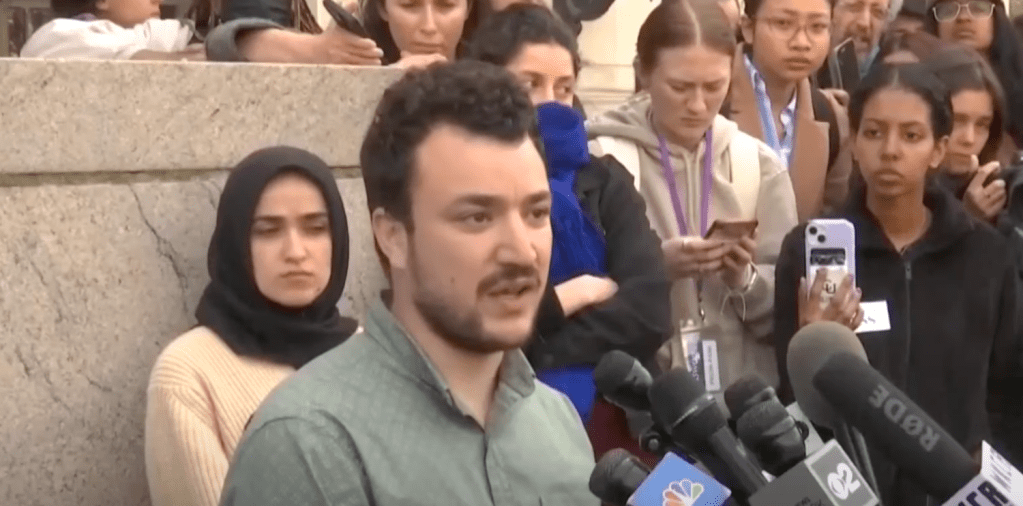
Khalil is a legal permanent resident of the United States. Both legal and undocumented people within the U.S. territories are entitled to Constitutional protections such as the First, Fifth and Sixth Amendments (freedom of speech, freedom from unreasonable search and seizures, due process and right to counsel).
Khalil was arrested on March 8, 2025 and set to be deported. The government claimed that he was a threat to the United States due to his involvement in anti-war protests in support of Palestine. The government claimed that Khalil was engaging in anti-semitism and supporting Hamas, an organization deemed a terrorist organization by the U.S. government. The Judge presiding over Khalil’s case ordered the government to produce evidence for its detention and potential deportation of Khalil.
On April 10, 2025, the government submitted a memo signed by Secretary of State, Marco Rubio, in support of its position to deport Khalil. The memo essentially states that under INA section 237(a)(4)(C)(I), the Secretary of State must personally determine that the “alien’s” presence or activities would compromise a compelling U.S. foreign policy interest, and deem the person deportable.
This is clearly a subjective test as to what constitutes an activity or presence that compromises a compelling U.S. foreign policy interest.
Although, this would be subject to a court’s review, it nonetheless raises serious concerns about the reach of the government. If the government is allowed to subjectively label a person’s presence or activities as compromising a compelling U.S. foreign interest, it opens the door to authoritarianism.
If the government is allowed to violate a lawful permanent resident’s first amendment rights, will this then transpire to U.S. citizens? The answer is yes! If the government is allowed to prioritize so-called foreign policy interests over lawful permanent residents then it takes us a step closer to allow the government to prioritize “foreign policy interests” over U.S. citizens.
Although in this case the consequence is detention and deportation, the alternative for a U.S. citizen could easily be detention and/or prohibition of their first amendment rights.
How does this affect the working class?
There was a time in the U.S. when being associated with the communist party or even communist beliefs led to government persecution and deportations. This period is referred to as the “Red Scare of the 1920’s.” Most importantly, labor strikes were considered a sign of communist influence and labor unions were targeted. It may appear that Unions would not be a target in the present day, as they are now widely accepted. However, Trump has shown his lack of support for labor unions.
If labor unions were to organize and there is a rise of labor unrest and/or strikes, we can see how easily the government can deem the strikes as compromising compelling U.S. foreign policy interests, as it relates to trade and tariffs. This would significantly reduce the power and influence of the working class.
These fears extend to anybody beyond the labor movement as well. Should any American be deemed a threat for any reason, even without evidence, they may be subject to the interests of the state without proper constitutional protections.
 Zinnia
Leave a comment