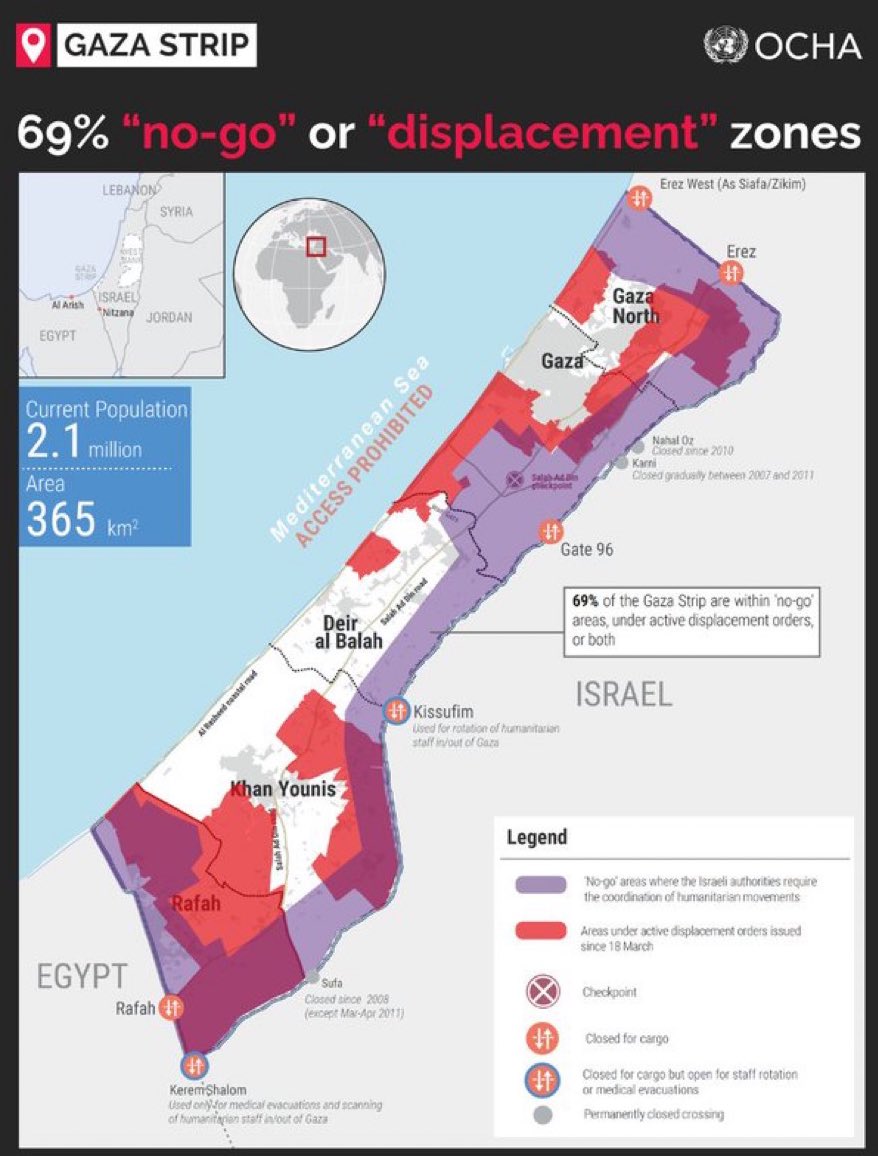
Between March 18 to April 14, the Israeli military issued 20 displacement orders, forcibly relocating and displacing hundreds of thousands of Palestinians to ever decreasing zones within the Gaza strip. Over two thirds of the Gaza strip are now under these “No-Go” zones, cutting off connections within the strip and with Egypt as well, which has historically been the only crossing in and out of the Gaza strip not controlled by Israel, and a crucial crossing point for humanitarian aid.
The displacement zones also disconnect cities such as Rafah, Khan Younis, and Gaza city from each other within the stip. Israeli Defense Minister Israel Katz has stated that Israeli military forces will remain in the designated security zones that it has established within the Gaza strip through seizure of Palestinian land. These zones will serve as corridors for the Israeli Military to occupy the Gaza Strip and will allow the military to further monitor and control the movement of Palestinians.
Additionally, Katz has declared that “all of Rafah will be evacuated and there will be a security zone”. This is especially concerning as Rafah has served as a shelter for Palestinian refugees fleeing Israeli-caused destruction elsewhere in the Gaza strip, also serving as a reception point for humanitarian aid, and as a connection to the Egyptian border for those seeking emigration.
Defense Minister Israel Katz has also stated: “Gaza will become smaller and more isolated, and more and more of its residents will be forced to evacuate from the fighting zones.”
In conjunction with the implementation of these displacement zones, Israel has been blocking the entry of any humanitarian aid into Gaza. The UN has shared that the Palestinian Refugee Agency (UNRWA) has humanitarian supplies stockpiled outside of the Gaza strip. The only barrier to delivery is the refusal by the Israeli government to allow that aid to enter. The UNRWA has has warned that “supplies inside Gaza are nearly all gone, with food stocks running dangerously low and only 250 food parcels left”. Israel has blocked the entry of any food, medicine, and other humanitarian aid since March 2.
U.S. foreign policy has played a crucial role in the development of this conflict and can play a crucial role in pressuring a ceasefire. U.S. arms manufacturers and foreign policy diplomats provide Israel with a majority of its military and economic support, allowing the Israeli military to conduct its actions on the scale that it currently operates. As many have pointed out, the administration in power in the U.S. can pressure ceasefire negotiations by withholding said military and economic aid. However, this is a power not exercised by U.S. administrations.
 Zinnia
Leave a comment