If you can’t modify your data as you please, do you really own it? Say, a while back, you wanted to buy yourself a new book. So, you head to Amazon to buy an e-book that’s compatible with your Kindle. You also make sure to download a copy to your computer since anything on someone else’s computer is under their control. Say now, you come back on Feb 26, 2025 to see that Amazon has removed your ability to independently own your book. By removing the right to download the book to your computer and have sole control over your copy you are now dependent on Amazon making this book available to you in perpetuity. You are also dependent on Amazon not changing the contents of what you now provisionally own. Which they already do. To depict this theft, they’ve “quietly and with no clear evidence of a disturbance” made changes to books among the likes of Roald Dahl, R.L. Stine, and Agatha Christie. The precedent has been set, it’s only a matter of time before the platform shifts again. Next time, it could be a far more pressing issue; one that will form sides.
Control your data
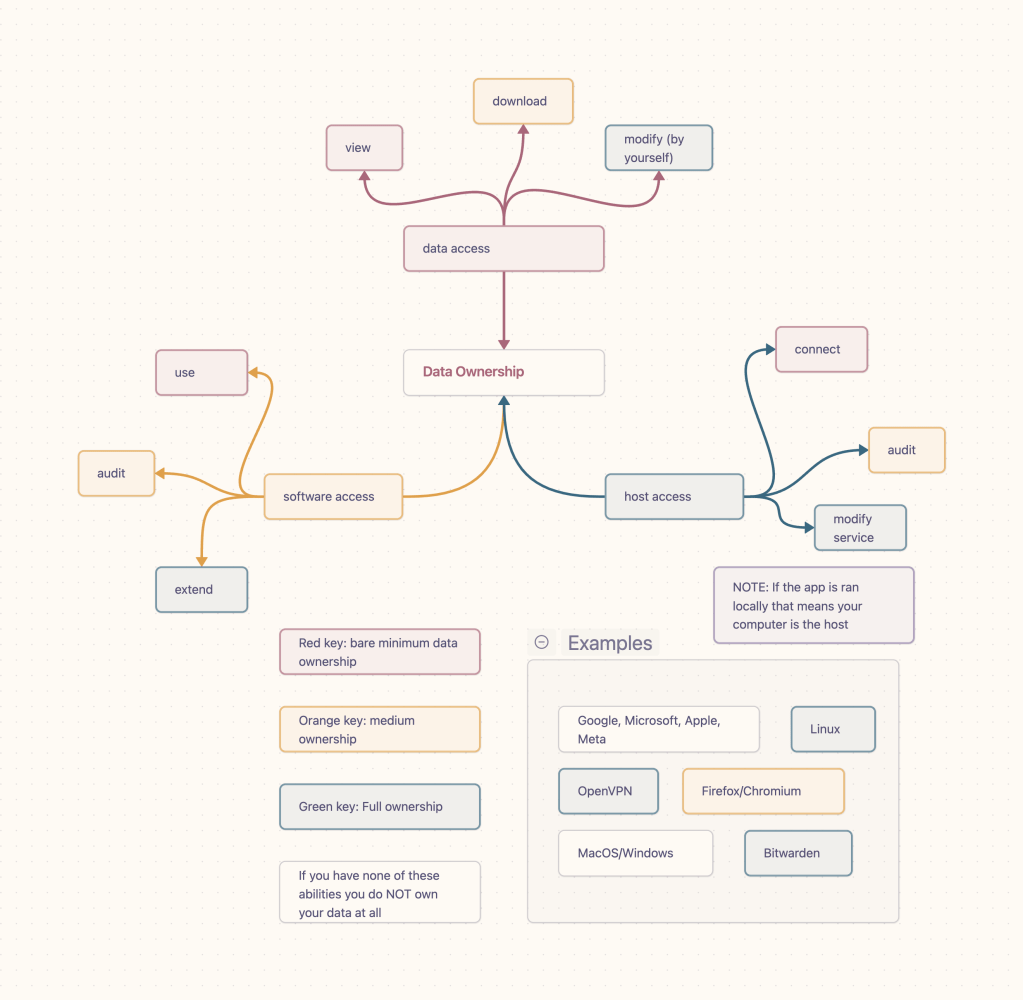
That doesn’t really sound like ownership to me. Just like the physical realm, your data is a raw resource that needs to be processed. In the digital realm, the tool to process this data is the editor. Yet again, there’s levels to this kind of ownership. In the aspect of software editors, you must be able to use your data (as you please), you must be able to audit the software (to guarantee it does as it says), and you must be able to extend the software as needed (you determine your workflow). This is what complete data sovereignty looks like. To move to complete digital sovereignty and secure digital presence, you must go further.
Beside owning the software you use, sits owning your data. Your data is what you put into some software and anything that’s generated by the software. Data ownership exists as a type of spectrum, it itself has three key properties that must be fulfilled for true ownership. You must be able to control your access to this data, you must be able to control where this data exists (control of storage), and you must be able to control modification this data. In the opening examples, Amazon infringed upon the individual’s right to own by removing their right to download and right to control modifications.
To have complete access to your data is the entryway, but your ownership of this key can be hidden behind software. In this aspect of data ownership, your data may be useless without the ability to modify it. True digital ownership is the peace of mind that absolutely no one can change your control over: your access your data, your store of your data, and modifications to your data. That may sound insurmountable , but all of it can be achieved. Doing all of that would be equivalent to moving beyond data independence and editor independence. Yet, what if my data was never on my computer?
Know your host
There’s still one frontier that remains, host independence is needed. In it’s simplest form, this is any software that you run fully from your computer, where your computer is the host. In it’s typical form, this is what we know as the modern internet. Datacenters of computers serving some platform’s goals. This is where most people go to do their banking, document backup, or be entertained. It is undeniable nowadays that there are domains that need the large processing power of a remote computer. However, when using hosted software you have a new problem to account for. In order to be completely sovereign, you need the ability to freely connect to this service, you need the ability to audit the host, you need the ability to control the environment of the host. Due to the last clause this is precarious in practice and thus you’ll be forced to host these services yourself. To see how to do this and what’s available begin with Futo’s guide to a self managed life
Side note about controlling the environment and running something locally, you may own the hardware, but if you’re running closed source software you’re giving your keys to the castle away. To truly own your hardware, you must also own what it’s running. Taking this trip to owning your operating system will take you to Linux. The largest hurdle for Linux in the past has been gaming, but even there it’s starting to take over.
Side note about self-hosting, not every thing MUST be self-hosted for you to own it and be fully secure. There’s a middle ground where security is guaranteed, and additional layers can be used to guarantee service. For a simplified example, someone can use SimpleX as their messenger and will guarantee the same security and availability while not having host access.
Software doesn’t need to be made this way
The counter culture of the internet has been avoiding these known infringements of rights since the internet allowed commercial traffic. Their ideals have been Copyleft licensing (improvements must benefit all), systems that require zero trust from you, and collectively computing for large tasks. Some modern analogs to this is GPL Licensing, zero-trust, and Peer2Peer networking. I won’t do the dreaming for you, but can you imagine a world where software works for us without the ability to work against us all?

 Zinnia
Leave a comment