Author: Luis Vergara Murayama

  • Why the Working Class Should Be Worried About the Case of Khalil Mahmoud

    Why the Working Class Should Be Worried About the Case of Khalil Mahmoud

    Khalil is a legal permanent resident of the United States. Both legal and undocumented people within the U.S. territories are entitled to Constitutional protections such as the First, Fifth and Sixth Amendments (freedom of speech, freedom from unreasonable search and seizures, due process and right to counsel).

    Khalil was arrested on March 8, 2025 and set to be deported. The government claimed that he was a threat to the United States due to his involvement in anti-war protests in support of Palestine. The government claimed that Khalil was engaging in anti-semitism and supporting Hamas, an organization deemed a terrorist organization by the U.S. government. The Judge presiding over Khalil’s case ordered the government to produce evidence for its detention and potential deportation of Khalil.

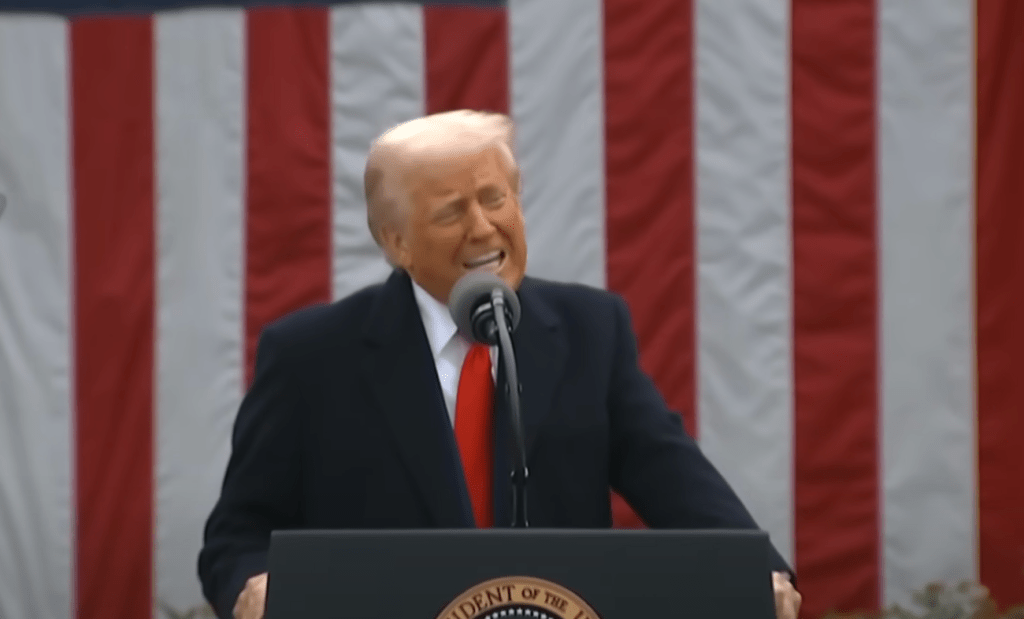
    On April 10, 2025, the government submitted a memo signed by Secretary of State, Marco Rubio, in support of its position to deport Khalil. The memo essentially states that under INA section 237(a)(4)(C)(I), the Secretary of State must personally determine that the “alien’s” presence or activities would compromise a compelling U.S. foreign policy interest, and deem the person deportable.

    This is clearly a subjective test as to what constitutes an activity or presence that compromises a compelling U.S. foreign policy interest.

    Although, this would be subject to a court’s review, it nonetheless raises serious concerns about the reach of the government. If the government is allowed to subjectively label a person’s presence or activities as compromising a compelling U.S. foreign interest, it opens the door to authoritarianism.

    If the government is allowed to violate a lawful permanent resident’s first amendment rights, will this then transpire to U.S. citizens? The answer is yes! If the government is allowed to prioritize so-called foreign policy interests over lawful permanent residents then it takes us a step closer to allow the government to prioritize “foreign policy interests” over U.S. citizens.

    Although in this case the consequence is detention and deportation, the alternative for a U.S. citizen could easily be detention and/or prohibition of their first amendment rights.

    How does this affect the working class?

    There was a time in the U.S. when being associated with the communist party or even communist beliefs led to government persecution and deportations. This period is referred to as the “Red Scare of the 1920’s.” Most importantly, labor strikes were considered a sign of communist influence and labor unions were targeted. It may appear that Unions would not be a target in the present day, as they are now widely accepted. However, Trump has shown his lack of support for labor unions.

    If labor unions were to organize and there is a rise of labor unrest and/or strikes, we can see how easily the government can deem the strikes as compromising compelling U.S. foreign policy interests, as it relates to trade and tariffs. This would significantly reduce the power and influence of the working class.

    These fears extend to anybody beyond the labor movement as well. Should any American be deemed a threat for any reason, even without evidence, they may be subject to the interests of the state without proper constitutional protections.
  • No, The Trump Administration’s Tariffs are Not Pro Working Class

    No, The Trump Administration’s Tariffs are Not Pro Working Class

    As the Trump administration proceeds with increased tariffs on Chinese imports climbing as high as 145%, the cost on the working class will be ever more apparent. Tariffs, which function as a tax on the importer, not the exporter, will encourage importing companies to pass the cost onto the working class, raising prices on various goods and contributing to the hardship that many American families already face. However, the question begs if a return to normalcy will solve the problem for the average worker.

    Trump’s Tariffs come as an unraveling of the era of Free Trade, which was marked by policies and agreements between nations that sought to eliminate barriers to trade, such as tariffs and other regulatory measures.

    These agreements, however, opened the door for industry leaders to export their manufacturing to countries where labor was much cheaper in order to cut costs and increase profit margins. This in turn contributed to the outsourcing of American manufacturing jobs, which not so coincidentally were “traditional bastions of unionization,” further contributing to the decline of pro-worker organizations; Our Trade Unions.

    These Free Trade Agreements resulted in the decline of manufacturing jobs in the U.S. and thus the decline in unionized jobs which contributed to growing wage inequality, actively working against the working class.

    Now, Trump’s tariffs are no solution either. While the Administration claims that the tariffs are an attempt to bring back manufacturing to America and to support the working class, they have done little to support either.

    The imposition of tariffs without first creating a competitive domestic manufacturing base, which the U.S. lacks due to decades of offshoring, will leave the working class with no domestic option to buy from in order to avoid the tariffs. American workers will have no other option but to purchase from price hiked foreign products, weakening their purchasing power.

    Additionally, the Administration has done little to promote domestic manufacturing or to engage in the construction of factories and resource extraction industries that would perform competitively with Chinese manufacturing.

    Should the return of American manufacturing jobs be the case, the Trump Administration has shown no interest in supporting workers rights or respecting union bargaining. There is no reason to believe that the return of American manufacturing under this administration would guarantee sufficient wages, safe working conditions, reasonable hours, or the numerous other benefits which unions have won for the working class.

    The resolution of the administration’s tariff war will only be a victory for corporate elites who will continue to profit off of cheap labor markets in other countries, or in a new, cheap American labor market.

  • How The Profit-Economy is structured

    How The Profit-Economy is structured

    We all know that any Industry is guided by the profit motive, but we want to look into the actual structures which produce this behavior. Beyond the general culturally imbedded desires to seek more and more profits, there are also real pressures which require an Industry, whether it be agricultural, pharmaceutical, tech, etc to seek constant profit.

    We’ll put it nice and short: Essentially all Industry, no matter how large, has investors and shareholders who invest their own money into an Industry so that the Industry has the resources required to operate at a competitive capacity.

    If those investors feel as though the performance of that Industry is failing or will fail to give them returns on their investment, they pull out their investment, as the reason they invest is to receive returns.

    For Industry, losing investors can be disastrous. This lack of investment could mean ceasing operations or failing to have the resources to perform competitively, ultimately leading to their demise in the long run. They may have to downsize, increase prices, sell capital, etc.

    So for Industry leaders, they are compelled to pursue profits often at the expense of their own workers and of the working class in order to meet the interests of investors and shareholders to prevent going under, losing to competitors, or losing their job.

    Understanding this structure is crucial to understanding the actions and motivations of any private Industry, from the systemic usage of pesticides to increase yields to increase profit, to gouging the prices of prescription medicine, to moving production offshores where labor is cheaper, to underpaying their workforce, etc.

  • March on Washington over U.S. support for Israeli Genocide of Palestinians

    March on Washington over U.S. support for Israeli Genocide of Palestinians

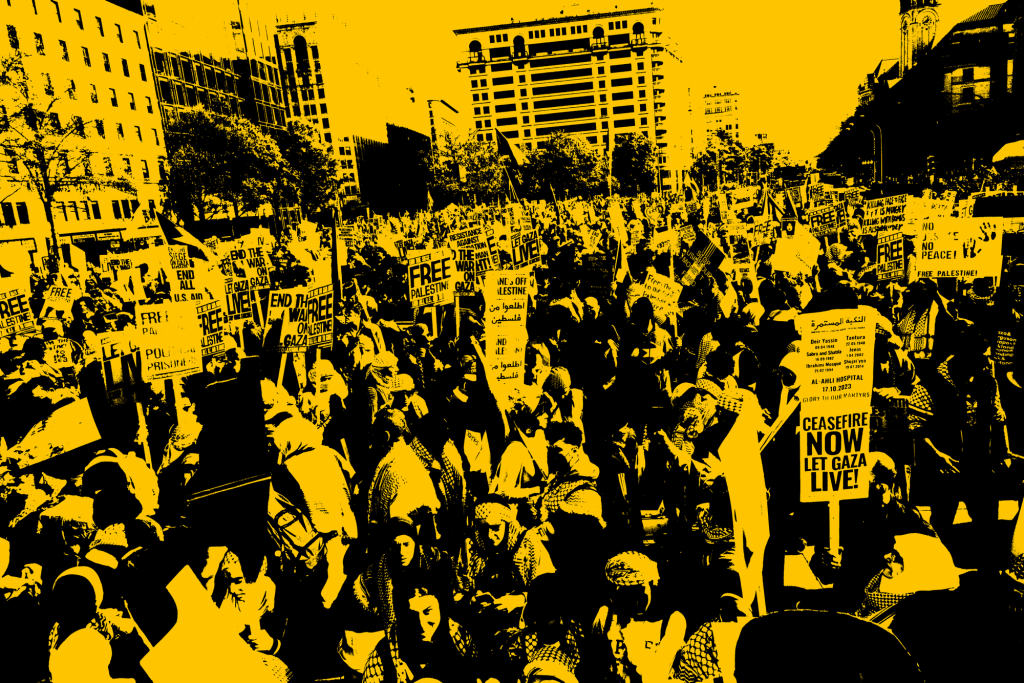
    On Saturday April 5th 2025, thousands showed up in Washington D.C. to protest the ongoing genocide by Israel against the Palestinians. The event featured many speakers who highlighted the history and struggles of the Palestinian people as well as the goal for Palestinian liberation. The march was hosted by a series of organizations under the “March on Washington” banner, saying this about their movement:

    “This movement is made of students, workers, teachers, artists, activists, healthcare workers, tech workers and people of conscience all over the world who will not back down in the face of repression and intimidation, and will never back down so long as Gaza is under attack. That’s why on April 5th we are standing up to Trump and his ethnic cleansing plan for Gaza, we are standing up to repression, and we are standing up to the US’s continued facilitation of the genocide in Gaza. We demand a permanent ceasefire and an arms embargo now!”

    The goal is to encourage the U.S. government to withdraw its support as the primary supplier of military and financial aid to the Israeli government, which provides the Israeli Government with the means to conduct military operations in civilian centers. The U.S. government supplies Israel with about 69% of its arms, including bombs, missiles, jets, ammunitions and small arms, to include a few.

    The U.S. withdrawal of that support would mean the inability for the Israeli government to conduct its military operations on its current scale, which has resulted largely in civilian causalities, leading to about 50 thousand deaths of children, parents, reporters, and first responders.

    Additionally, U.S. funding to Israel has reached about $18 billion in military aid and counting since October 7th 2023, not including what the U.S. has given the Israeli government previously, costing the American tax payers billions while our schools, libraries, and public assistance programs struggle for proper funding.

    Many of the speakers called for a U.S. embargo on military aid, demands of justice for political prisoners, and for an end of Israeli occupation of historically Palestinian lands.

    One event speaker, Taher Dahleh from the Palestinian Youth Movement said: “Politicians in government everyday either choose to meet the people’s needs in housing, in healthcare, education, in access to food, or they can choose to continue sending billions of dollars to Israel for its war of extermination”.

    The Trump administration has continued its support for Israel, approving $7 billion in an arms package in February of 2025.

    Monadel Herzallah from U.S. Palestine Community Network says about Palestinian Liberation: “It’s about what kind of world that we are going to be living in, and what kind of world we leave behind for our children. That is what’s at stake. We will not accept to live in a world where genocide is normal.”

  • The Working Class will bear the brunt of the Liberation Day tariffs

    The Working Class will bear the brunt of the Liberation Day tariffs

    On Wednesday evening, President Trump announced a series of tariffs that will be placed on imports from over 180 countries. While Trump has claimed that this will make America wealthy, the effects of the tariffs say otherwise. The tariffs will be reaching far into the pockets of working class Americans. Let’s take a look at a few of the coming consequences, leading to increased prices on all goods, both foreign and domestic.

    HOW TARIFFS INCREASE THE PRICES OF ALL GOODS

    While it may seem at first that the tariffs will be imposed on foreign companies, the price of the tariff quickly passes down to the consumer. We’ll follow the ladder down from point of import to point of purchase by the consumer

    • Manufacturers (think automakers, tech producers, etc), wholesale companies, or big retailers (think Target, Walmart, etc.) import materials to produce or import goods from abroad. Increased tariffs mean manufacturers and retailers must now pay an additional “tax” on all items coming in from abroad.
    • In order to protect their profit margins after paying increased prices on imported goods and materials, the business passes off the cost to the next buyer, this increases prices of products. Manufacturers pass off the cost to the distributor and the distributor to the retail stores, and retailers to consumer.
    • Example: Big Retailer purchases televisions from supplier country for $100. Tariffs now impose a 30% cost increase on TVs from supplier country, raising the cost to $130. Big Retailer, looking to protect their profits, now sells the TVs for 30% more, which the consumer ultimately buys for $130 instead of $100.

    Increased tariffs don’t just impact imported goods and materials either. Domestic retailers will also inevitably join in on the increased prices. If foreign TVs now cost $130, domestic producers will be inclined to join in and sell theirs for $120, taking advantage of the inflated market to increase profit margins, which has historically been the case.

    Such wide sweeping tariffs on almost every nation, virtually every product will be affected, as they are either constructed with materials from these countries, or are assembled in these countries. You will be hard pressed to find a product whose materials were mined, assembled, and sold entirely with the U.S., subjecting almost all goods to increased prices.

    Even if the expressed intent is to increase American manufacturing, almost every manufacturer relies on imported raw materials. We rely on foreign lithium, iron, cobalt, bauxite, rubber, etc. Not only would the U.S. now have to ramp up manufacturing immediately, but it would also have to ramp up production of every raw material on earth. Unless the U.S. can completely source all materials and manufacture all goods within the nation, the working class will be subjected to ever increasing prices on nearly every product on the market and worsening inflation.