Tag: Opinion

  • Opinion: How they use “Criminals” to Take our Rights Away

    Within Donald Trump’s first 100 days in office, we have seen several highly controversial cases, from the arrest of Mahmoud Khalil and the revoking of his green card, the arrest of Mohsen Mahdawi and the threat of removal of his green card, to the illegal and unjust deportation of Kilmar Abrego Garcia, to the detainment of U.S. citizens and high profile lawyers at points of entry, and to ICE agents smashing car windows illegally to detain individuals, among many other cases.

    In each of these instances, we see the administration pushing the limits of our constitutional protections, from arrests for exercising the right to free speech, to the blatant refusal to provide due process, to illegal search and seizure. And while the administration claims it’s only targeting criminals, they have been detaining U.S. citizens as well.

    In fact, in many of these cases, these individuals were otherwise law abiding residents. However, the framing of these individuals as criminals only serves to manufacture consent for these illegal actions, allowing the administration to test the limits of our rights.

    Khalil, Mahdawi, and Abrego serve as particularly effective targets. They are individuals who were law abiding or had proper legal protections. They are individuals who are in the same legal position as most other law abiding residents. If the administration can successfully violate their rights, they can successfully violate anyone else’s. Point being, this will not stop at the “criminals,” this will inevitably affect everyday Americans.

    Law is based off of precedent, so if precedent exists to remove the green cards of people who were exercising their right to free speech based solely on vague claims and loose evidence, then precedent exists to remove the green cards of otherwise law abiding residents based off of loose and vague claims as well. If the administration can get away with deporting a legally protected migrant, then they can get away with deporting any other legally protected migrant.

    This falls in line with the administrations own stated goals. Donald Trump, throughout his campaign repeatedly praised Operation Wetback, which infamously deported legal residents as well as U.S. citizens. He ran on promises to repeat a similar project. If the administration can get away with the deportation of Abrego, Khalil, and Mahdawi, then it establishes the precedent for the administration to fulfill its goal of mass deportations of migrants, legal residents included.

    For example, Kilmar Abrego Garcia is not a criminal, and in fact is in a very similar position to many migrants you may know: migrants who are allowed to stay on work permits, asylum, withholding of removal, etc. If the Administration gets away with the unjust deportation of Abrego and establishes that as precedent, then it establishes precedent to do the same with your neighbor, your friends, your family.

    Khalil and Mahdawi were green card holders who violated no laws, they only exercised their right to free speech. If the administration can get away with the revoking of their green cards and their deportations, then it sets the precedent to do the same with other law abiding green card holders.

    The framing of these individuals as criminals only serves to manufacture consent amongst the public for the government to test and unravel our constitutional rights without anyone batting an eye. This will ultimately set precedent for the very same things to happen to you or to people you know.

    It isn’t just a migrant issue either. If the administration can simply arrest and deport any individual or ship out any detainee, citizen or not, to a foreign country and subvert any due process, then they can target just about anyone for any reason with no evidence whatsoever.

    This isn’t just about “criminals.” This could open the door to political suppression and dangerous overreach towards anyone the government determines as an enemy: dissidents, political opponents, disruptive legal professionals, etc. In the worst case scenario, you are who the government says you are, and if you’re deemed to be a criminal, what due process do you have to say otherwise? What sort of power do you have to say otherwise?

  • Opinion: Why Kilmar Abrego’s Case Could Pose a Threat to Our Constitution

    Opinion: Why Kilmar Abrego’s Case Could Pose a Threat to Our Constitution

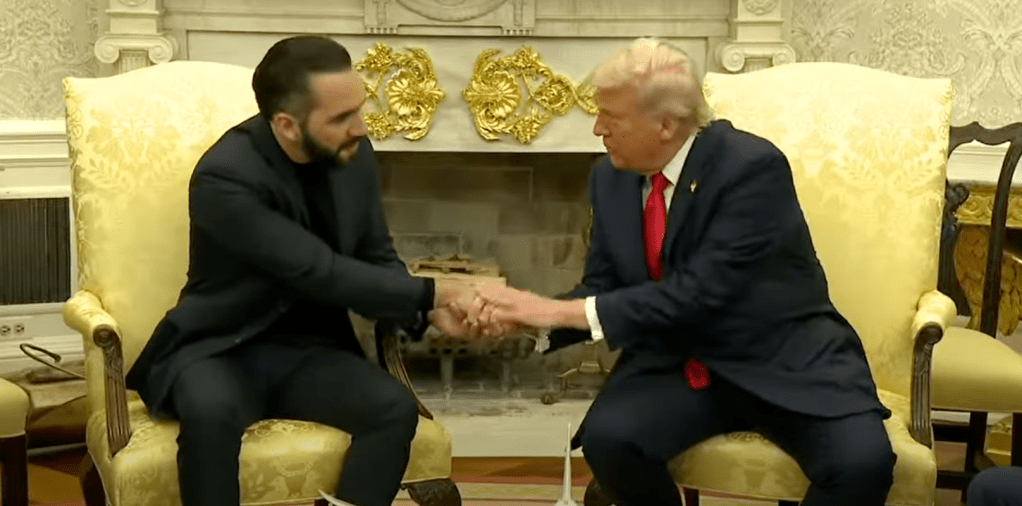
    Kilmar Abrego Garcia’s case has presented the Trump administration with unprecedented circumstances which could put into question our constitutionally protected right to due process, and the system of checks and balances intended to prevent authoritarian control by any branch of government. This comes after Salvadoran President Nayib Bukele’ visit to Washington and his stated unwillingness to send Abrego back to the U.S. Let’s take a look at what’s at sake.

    Due Process

    Abrego, who had been granted withholding of removal, was deported to El Salvador without due process. The Fifth Amendment of the U.S. Constitution states that the federal government cannot deprive one of “life, liberty or property without due process of law.” This applies to all persons within the U.S., including non-citizens.

    Due process is understood as the obligation that our government has to give someone who has been accused of a crime the right to a fair trial, which was denied to Kilmar Abrego. Not once before getting sent to CECOT did Abrego have an opportunity to argue his defense, to present to a court his valid immigration status, or to refute the baseless claims about ties to MS-13.

    This administration has shown its willingness to punish someone without abiding by the constitutionally guaranteed right to due process, which should ring an alarm for anyone who has an interest in protecting our rights. The administration has also presented a dangerous model to imprison anyone without due process by sending detainees to countries outside of the jurisdiction and claiming they can do nothing about it. It provides a framework for authoritarian jailings beyond the power of U.S. citizens.

    This presents a loophole to undermine any person’s constitutional rights. It establishes a framework for an authoritarian government to arrest anyone, ship them off to a foreign prison and claim that the individual is outside of U.S. jurisdiction and that nothing can be done.

    As the Fifth Amendment does not pertain solely to citizen or non-citizen, these actions put at risk the right that all people have to due process as we know it. It could also potentially set precedent for the government to take action against anyone for any reason, imprisoning anyone without providing a fair trial.

    💡
    Following the meeting with Trump and Bukele in Washington on April 14, 2025, Trump has reportedly claimed that “home-grown’s are next”.

    Checks and Balances

    While the Supreme Court has upheld the decision by a lower court to “facilitate” the return of Kilmar Abrego Garcia, the constitution provides no way for the courts to enforce their decision. The separation of powers and system of checks and balances relies on the recognition of the court’s authority by the other two branches and in this case, the Executive.

    The administration has argued that US officials cannot compel the Salvadorian government to return him. However, the deportation of prisoners to El Salvador is a paid agreement between the two countries, an agreement which theoretically may be terminated. The funds which the U.S. has given El Salvador are reportedly to assist in the funding of the Salvadorian Prison system, which the U.S. government could use as leverage to pressure Abrego’s return.

    Additionally, while Bukele states that he does not have the power to return him to the United States, the Salvadoran Government has extradited Salvadoran citizens to the U.S. allowing the U.S. government to fulfill it’s constitutionally mandated duty to provide due process. The U.S. and El Salvador also have an extradition treaty, giving both governments full power to send Abrego back should this administration have full intent to engage in its constitutional responsibilities.

    This goes to show the multiple different avenues and historical legal precedent which the administration can use to follow the court’s orders, which should be quite easy for an “expert negotiator”.

    If the Administration should proceed to resist, this may put into question the extent of the power that the Judiciary has. It could set extremely dangerous precedent which undermines the systems of checks and balances designed by the constitution and creates a framework for the authoritarian imprisonment of anyone, citizen or not, without a trial.

  • Why the Working Class Should Be Worried About the Case of Khalil Mahmoud

    Why the Working Class Should Be Worried About the Case of Khalil Mahmoud

    Khalil is a legal permanent resident of the United States. Both legal and undocumented people within the U.S. territories are entitled to Constitutional protections such as the First, Fifth and Sixth Amendments (freedom of speech, freedom from unreasonable search and seizures, due process and right to counsel).

    Khalil was arrested on March 8, 2025 and set to be deported. The government claimed that he was a threat to the United States due to his involvement in anti-war protests in support of Palestine. The government claimed that Khalil was engaging in anti-semitism and supporting Hamas, an organization deemed a terrorist organization by the U.S. government. The Judge presiding over Khalil’s case ordered the government to produce evidence for its detention and potential deportation of Khalil.

    On April 10, 2025, the government submitted a memo signed by Secretary of State, Marco Rubio, in support of its position to deport Khalil. The memo essentially states that under INA section 237(a)(4)(C)(I), the Secretary of State must personally determine that the “alien’s” presence or activities would compromise a compelling U.S. foreign policy interest, and deem the person deportable.

    This is clearly a subjective test as to what constitutes an activity or presence that compromises a compelling U.S. foreign policy interest.

    Although, this would be subject to a court’s review, it nonetheless raises serious concerns about the reach of the government. If the government is allowed to subjectively label a person’s presence or activities as compromising a compelling U.S. foreign interest, it opens the door to authoritarianism.

    If the government is allowed to violate a lawful permanent resident’s first amendment rights, will this then transpire to U.S. citizens? The answer is yes! If the government is allowed to prioritize so-called foreign policy interests over lawful permanent residents then it takes us a step closer to allow the government to prioritize “foreign policy interests” over U.S. citizens.

    Although in this case the consequence is detention and deportation, the alternative for a U.S. citizen could easily be detention and/or prohibition of their first amendment rights.

    How does this affect the working class?

    There was a time in the U.S. when being associated with the communist party or even communist beliefs led to government persecution and deportations. This period is referred to as the “Red Scare of the 1920’s.” Most importantly, labor strikes were considered a sign of communist influence and labor unions were targeted. It may appear that Unions would not be a target in the present day, as they are now widely accepted. However, Trump has shown his lack of support for labor unions.

    If labor unions were to organize and there is a rise of labor unrest and/or strikes, we can see how easily the government can deem the strikes as compromising compelling U.S. foreign policy interests, as it relates to trade and tariffs. This would significantly reduce the power and influence of the working class.

    These fears extend to anybody beyond the labor movement as well. Should any American be deemed a threat for any reason, even without evidence, they may be subject to the interests of the state without proper constitutional protections.

  • No, The Trump Administration’s Tariffs are Not Pro Working Class

    No, The Trump Administration’s Tariffs are Not Pro Working Class

    As the Trump administration proceeds with increased tariffs on Chinese imports climbing as high as 145%, the cost on the working class will be ever more apparent. Tariffs, which function as a tax on the importer, not the exporter, will encourage importing companies to pass the cost onto the working class, raising prices on various goods and contributing to the hardship that many American families already face. However, the question begs if a return to normalcy will solve the problem for the average worker.

    Trump’s Tariffs come as an unraveling of the era of Free Trade, which was marked by policies and agreements between nations that sought to eliminate barriers to trade, such as tariffs and other regulatory measures.

    These agreements, however, opened the door for industry leaders to export their manufacturing to countries where labor was much cheaper in order to cut costs and increase profit margins. This in turn contributed to the outsourcing of American manufacturing jobs, which not so coincidentally were “traditional bastions of unionization,” further contributing to the decline of pro-worker organizations; Our Trade Unions.

    These Free Trade Agreements resulted in the decline of manufacturing jobs in the U.S. and thus the decline in unionized jobs which contributed to growing wage inequality, actively working against the working class.

    Now, Trump’s tariffs are no solution either. While the Administration claims that the tariffs are an attempt to bring back manufacturing to America and to support the working class, they have done little to support either.

    The imposition of tariffs without first creating a competitive domestic manufacturing base, which the U.S. lacks due to decades of offshoring, will leave the working class with no domestic option to buy from in order to avoid the tariffs. American workers will have no other option but to purchase from price hiked foreign products, weakening their purchasing power.

    Additionally, the Administration has done little to promote domestic manufacturing or to engage in the construction of factories and resource extraction industries that would perform competitively with Chinese manufacturing.

    Should the return of American manufacturing jobs be the case, the Trump Administration has shown no interest in supporting workers rights or respecting union bargaining. There is no reason to believe that the return of American manufacturing under this administration would guarantee sufficient wages, safe working conditions, reasonable hours, or the numerous other benefits which unions have won for the working class.

    The resolution of the administration’s tariff war will only be a victory for corporate elites who will continue to profit off of cheap labor markets in other countries, or in a new, cheap American labor market.

  • How The Profit-Economy is structured

    How The Profit-Economy is structured

    We all know that any Industry is guided by the profit motive, but we want to look into the actual structures which produce this behavior. Beyond the general culturally imbedded desires to seek more and more profits, there are also real pressures which require an Industry, whether it be agricultural, pharmaceutical, tech, etc to seek constant profit.

    We’ll put it nice and short: Essentially all Industry, no matter how large, has investors and shareholders who invest their own money into an Industry so that the Industry has the resources required to operate at a competitive capacity.

    If those investors feel as though the performance of that Industry is failing or will fail to give them returns on their investment, they pull out their investment, as the reason they invest is to receive returns.

    For Industry, losing investors can be disastrous. This lack of investment could mean ceasing operations or failing to have the resources to perform competitively, ultimately leading to their demise in the long run. They may have to downsize, increase prices, sell capital, etc.

    So for Industry leaders, they are compelled to pursue profits often at the expense of their own workers and of the working class in order to meet the interests of investors and shareholders to prevent going under, losing to competitors, or losing their job.

    Understanding this structure is crucial to understanding the actions and motivations of any private Industry, from the systemic usage of pesticides to increase yields to increase profit, to gouging the prices of prescription medicine, to moving production offshores where labor is cheaper, to underpaying their workforce, etc.